
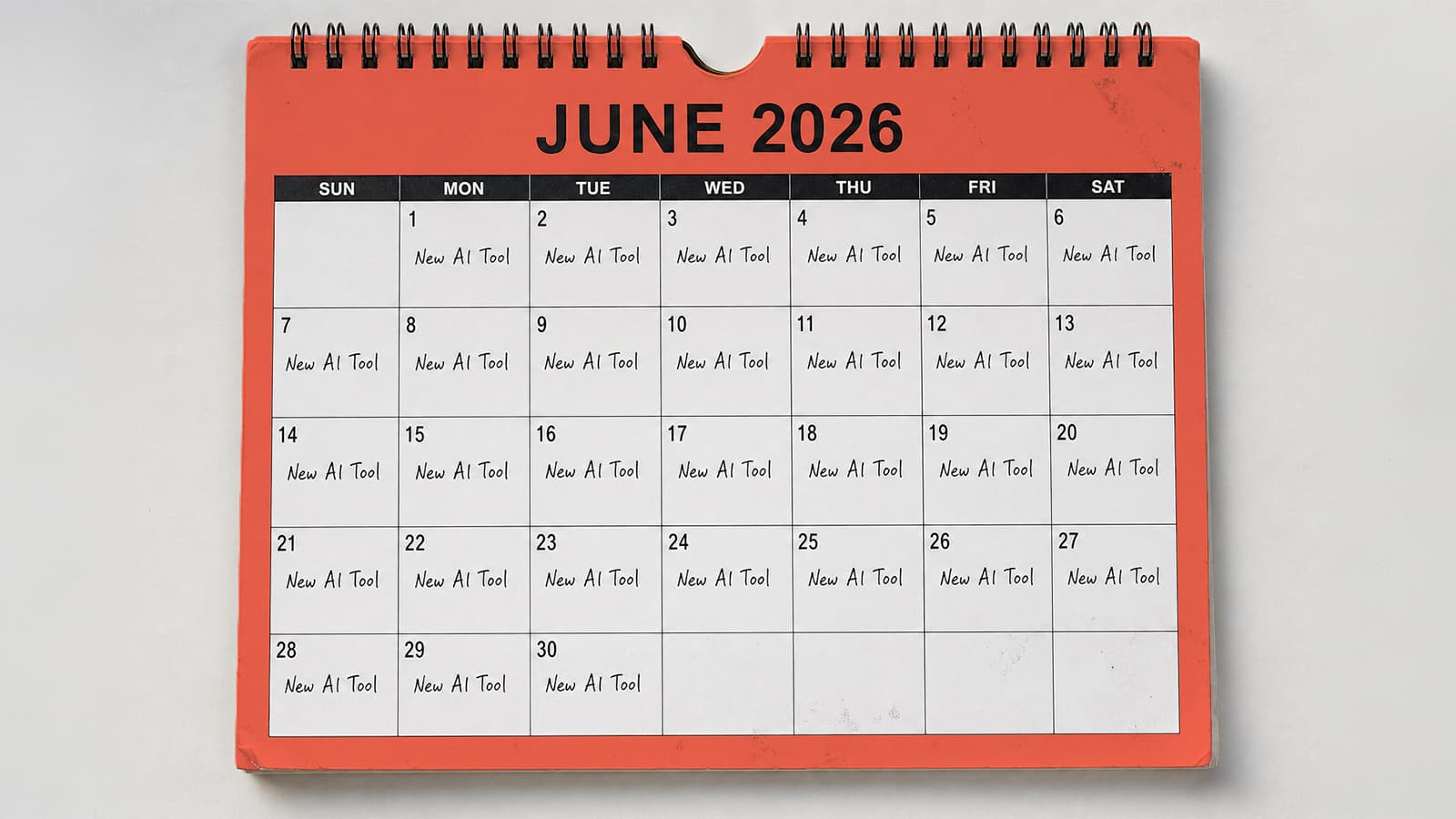
I was in a room full of creatives in Stockholm recently. Curious people, the kind who actively want to stay ahead of where things are going. So when the question came up of who in the room had built their own custom GPT, I assumed a lot of hands would go up.
One hand went up. Mine.
I sat there a little stunned, because in my own corner of the internet, building a custom GPT feels roughly as advanced as learning to send an email. I built my first ones two years ago. I have run workshops and taught other people to build theirs. In my feed the conversation has long since galloped off toward Claude and skills and cowork and agents and Codex and whatever gets announced while I am writing this sentence. And here was a room full of people who pay attention to where things are heading, the kind who lean in rather than look away, and almost none of them had tried the thing I had quietly filed under "old news."
That gap, the one between how far ahead the internet says everyone is and how far ahead people actually are, is the whole reason I wanted to write this. So let me say it plainly. You are not behind on AI. You are just comparing yourself to the loudest people online.
The internet runs on a false timeline
The loudest voices in AI live inside the tools. A lot of them are influencers who get early access, handed the new features weeks before the rest of us can even log in and find the button. So by the time a tool actually reaches you, they have already been testing it, posting about it, and making it look effortless for a month. They test features the day they ship, because for them the features did ship that day. They post their workflows. They make it look like every professional on earth has already automated their job and assembled a little AI staff to high-five in the mornings.
I know this because I am, embarrassingly, one of those voices. I spend several hours a day on this. Podcasts on walks, newsletters with breakfast, building things at night. I am very much not technical, and yet I build with Claude Code and then squint at what it made for me afterwards, trying to understand what I just did. Honestly, 24 hours is not enough to keep up, and I have made keeping up my actual job.
And here is the part nobody else seems to say. I did not come from tech. I am an enterprise marketer. I spent years at a big global brand, learning how marketing works at scale, with exactly zero lines of code to my name. And every so often I meet someone who makes me feel hopelessly behind, and then a few minutes into the conversation it comes out: "oh, I used to be a PM at a tech company." Or my personal favourite, "well, my degree is actually in data science, so I know how to code." Funny how that detail arrives second.
These people are not ahead of you because they are smarter or because they tried harder. They started the race fifty metres up the track and forgot to mention it.
I built all of this from the same line you are standing on, no computer science degree hiding in my back pocket. So when the loud, public version of AI makes you feel slow, remember how small and how far ahead that group started. It is almost never a fair picture of where most marketing teams actually are.
Where most teams actually are is the chat window, doing perfectly reasonable things. Rewriting an email. Getting a few headline options. Summarizing a long document nobody wanted to read. Treating AI like a slightly cleverer search bar. That is not failure. That is what the beginning looks like, and the beginning is a fine place to be. The trap is standing there judging yourself for it instead of asking the only question that helps: where could this actually save me time?
The first step is not another tool
If you feel behind, do not go shopping. Adding a fifth tool to a stack you are already not using is not progress, it is hoarding.
Look instead at the work you already do. What takes the most time every week? Where do you keep copying, rewriting, checking, starting from scratch on something that has the exact same shape every single time? Marketing is full of these: planning content, building campaigns, reporting, research, turning one thing into nine things. If you cannot see the shape of your own process, you cannot see where AI would slot into it, and then you end up chasing whatever tool a stranger was excited about on Tuesday. That is where the noise wins.
So pick one process. Not the whole department, not the company. One thing you repeat often enough that fixing it would genuinely lighten your week. Then ask the tool where it could help inside that one thing. Could it sort the inputs, run a first pass, check the work for consistency, build you a stronger starting point so your actual judgment goes where it matters. That beats trying to swallow the entire field in a weekend.
Ask bigger questions
The strange thing about how adults use AI is how fast we shrink the question.
We ask for a tidier email when we could ask it to rethink the whole process that email sits inside. We ask for a caption when we could ask which part of our content workflow is repetitive enough to hand over entirely. We ask for a quick idea when we could ask what it would need from us to make that idea any good.
I heard an engineer from Anthropic talking on a podcast about why kids are so much better at this than we are. Not more technical. They just do not assume the tool only belongs in one tiny box. They ask it enormous questions, ridiculous questions, questions that would never occur to a sensible adult with a calendar full of meetings. It made immediate sense to me.
Somewhere along the way we learned to be reasonable, and reasonable is exactly the wrong setting for this.
Think in roles, not features
When I started building my own GPTs, I did not think of them as software. I thought of them as the teams I used to run.
I have led marketing teams for years, so I knew the people I leaned on, and I rebuilt them one by one. A content person. Someone creative for the new brands I work with. Someone analytical to tell me when I was wrong. I named them after the roles, not after the tech, and the moment I did that they stopped being one overworked chat window I expected to do everything, and became colleagues I could hand specific jobs to. The content one and the creative one are the two I reach for most, probably because that is where most of my actual work lives.
If building a GPT still feels like a leap, start smaller and go deeper. Take the one tool you already pay for and learn what it actually does. Run a proper research query next time instead of a quick one. Try a GPT someone else already built. Ask the tool itself, in plain words, how it would help with the thing on your desk right now. The goal was never to become technical. It is to become intentional.
You need standards more than novelty
It is easy to mistake novelty for progress, because the AI world ships something new more or less daily and every release is announced like it changes everything. A few of them genuinely do. Most are last month's idea with a new name on it, and you can safely let them pass without feeling like you missed something.
For a marketing team the useful question is not whether you have heard of every new feature. It is whether you have decided how AI fits your work at all. What does it help with, what does it never get to decide on its own, what always gets a human read before it leaves the building. That is the thing most teams are actually missing, and it is worth more than any tool recommendation I could give you: a clear, boring, deliberate sense of where this belongs.
Because feeling behind tends to produce the wrong kind of motion. You follow more, save more, sign up for more, and somehow feel less sure than when you started. The grown-up move is smaller and quieter. One tool. One process. Learn what it can really do in that one place, then build out from there once.
You are not as behind as you feel
Remember the room where only my hand went up. Not long after, one of the people who had been there told me he had gone home, built his own GPTs, and could not stop. And I was quietly delighted, because that is the whole thing in miniature. Not a wave that swept past while you were answering emails. One curious person who picked one thing and tried it.
So start with the work in front of you. Pick the task that takes the most time. Look at how it actually works. Ask where AI could take over part of it. Try one small change. Then another.
That is not falling behind. That is adoption. Not a revolution arriving fully formed, but one useful task, one person, one better way of working at a time.